
Uprising - truth telling

War in the colony of New South Wales, 1838 - 1844
Artefact hosted the Sydney launch of Dr Stephen Gapps’ book Uprising, launched by fellow truth teller David Marr. Stephen is a public historian working to bring Frontier War histories into broader recognition as Australia’s First Wars and is the Senior Associate and Historian at Artefact.
Frontier resistance warfare
Building on the important historical findings of his first two books, in Uprising Stephen Gapps resurfaces the breadth of frontier resistance warfare between 1838 and 1844, from present-day northern Victoria through to southeast Queensland.
The book represents a critical contribution to truth-telling and revealing the silences in Australian history. Recognising and understanding our shared history is a vital process and at the core of our purpose at Artefact. The event, attended by more than 65 people marked an important moment in the ongoing conversation about Australian history. We are proud to support Stephen and his work in shifting entrenched narratives about the Australian past.
Dr Stephen Gapps is a public historian working to bring Frontier War histories into broader recognition as Australia’s First Wars and Senior Associate and Historian hat Artefact. In 2011, he was awarded the NSW Premier’s History Award for regional and community history. Stephen’s The Sydney Wars: Conflict in the early colony 1788–1817 was the inaugural winner of the Les Carlyon Award for the writing of military history (2020). He is also the author of Gudyarra: The first Wiradyuri war of resistance – The Bathurst War, 1822–1824 (2021), and is an editor of The Australian Wars, the book of the award-winning documentary series, forthcoming. He is also the Senior Associate and Historian at Artefact Heritage and Environment.
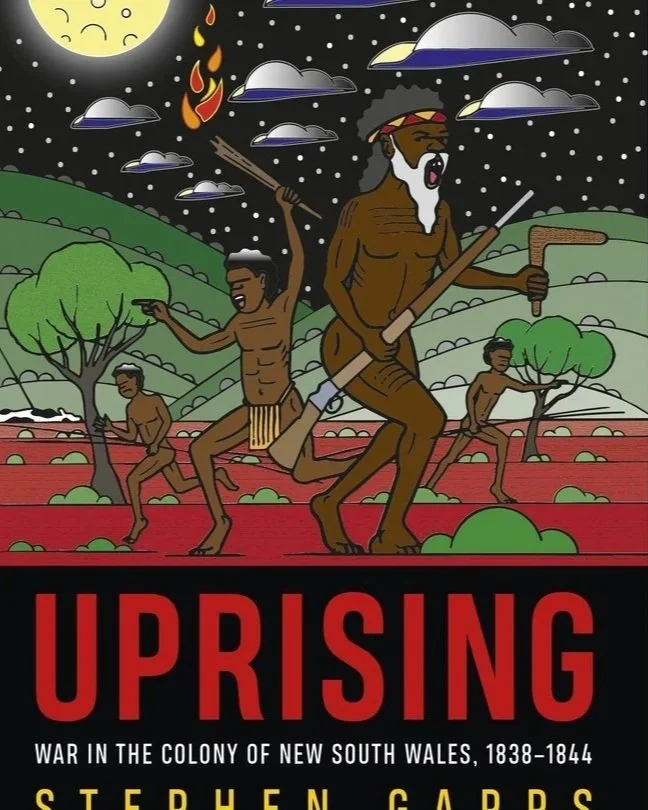
The first section of this book mainly cover Aboriginal victories in war. The second section deals with the colonial counteroffensive against the uprisings along the colonists' 'frontier'.
caption: Front cover of Uprising with artwork by Blak Douglas
The question arises – were they built with the conflict of Aboriginal resistance in mind? Or perhaps they were constructed this way for multiple reasons – as secure storage, but also as a refuge against bushrangers, thieves and Aboriginal warriors. Or perhaps they were built like this with the memory of war – in effect an acknowledgement of the conflict for the occupation of Aboriginal lands.
The paper responded to how a generation of research outlining conflict between First Nations people and the invading society has dramatically changed the historiography of the colonial period and the meaning of British settlement on the Australian continent.